Traditional Marketing vs Digital Marketing | Complete Guide for Pakistani Businesses (2026)
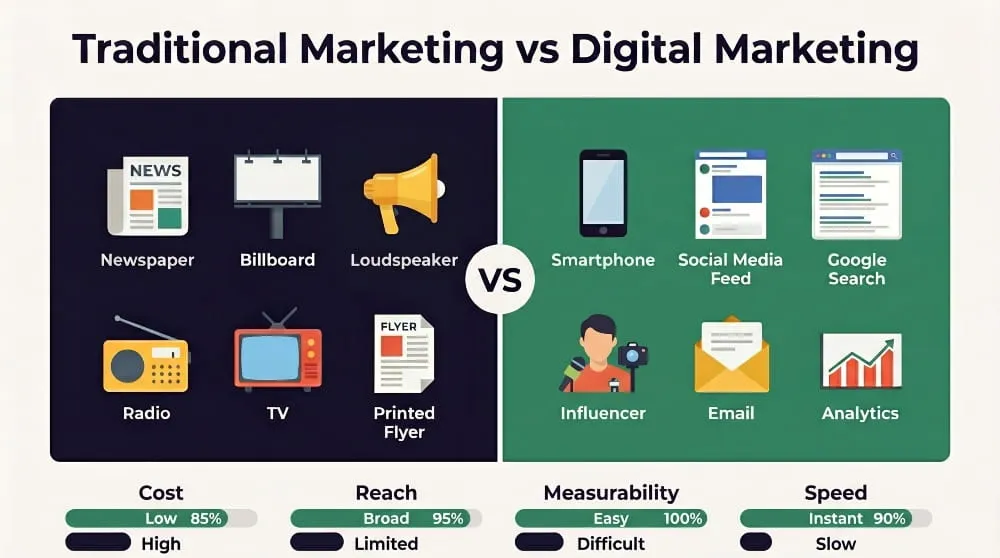
A few years ago, a business in Pakistan had one real choice when it came to marketing: print some flyers, book a newspaper ad, or, if the budget allowed, run a TV commercial. That was it. That was the game.
Today, that same business can reach thousands of potential customers in Karachi, Lahore, and Islamabad before lunch, without printing a single page.
This shift didn’t happen overnight, but it has changed everything about how Pakistani businesses grow, compete, and survive.
So what exactly is the difference between traditional marketing and digital marketing? Which one actually works? And more importantly, which one is right for your business?
This guide answers all of it. Whether you’re a business owner trying to make smarter decisions, a student studying marketing, or a professional looking to sharpen your strategy, by the end of this page, you’ll have a complete, clear picture of both worlds and exactly how they compare.
What Is Traditional Marketing?
Traditional marketing refers to any form of promotion that existed before the internet, the kind you can see, hear, or hold in your hands. It’s the newspaper ad you flip past with your morning chai, the billboard on MM Alam Road, the jingle playing on FM 101 during your commute, or the pamphlet someone hands you outside a shop in Anarkali Bazaar.
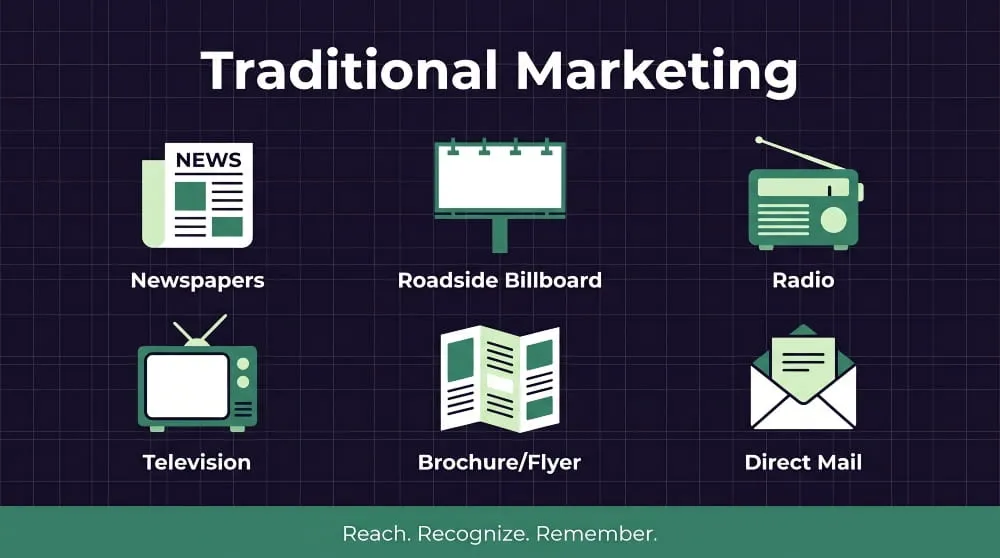
For decades, this was the only marketing that existed in Pakistan. Brands built their reputations through television commercials, radio spots, print ads in Jang or Dawn, and physical banners across busy intersections. It worked, and for many large brands, it still does.
Traditional marketing operates on a simple principle: get your message in front of as many eyes and ears as possible and hope enough of the right people are paying attention. It’s broad, it’s visible, and when done well, it builds powerful brand recognition.
The most common forms of traditional marketing used in Pakistan include:
- Print, newspaper ads, magazines, brochures, pamphlets
- Outdoor, billboards, hoardings, signboards, shop banners
- Broadcast, TV commercials, radio advertisements
- Direct mail, physical letters, catalogues, and promotional offers sent by post
- Events & sponsorships, trade shows, cricket sponsorships, and local exhibitions
Traditional marketing still carries real weight in Pakistan, particularly for reaching older demographics, rural audiences, and markets with limited internet penetration. A billboard on a major highway in Multan or a prime-time TV slot during Ramazan still commands serious attention.
But it comes with real limitations, and that’s exactly where digital marketing comes into play.
What Is Digital Marketing?
Digital marketing is any form of promotion that happens online, through search engines, social media, websites, email, or mobile apps. Instead of a billboard on a highway, it’s an ad that appears when someone in Lahore searches “best furniture store near me.” Instead of a TV commercial, it’s a 30-second YouTube video that plays only for people who actually match your target customer profile.
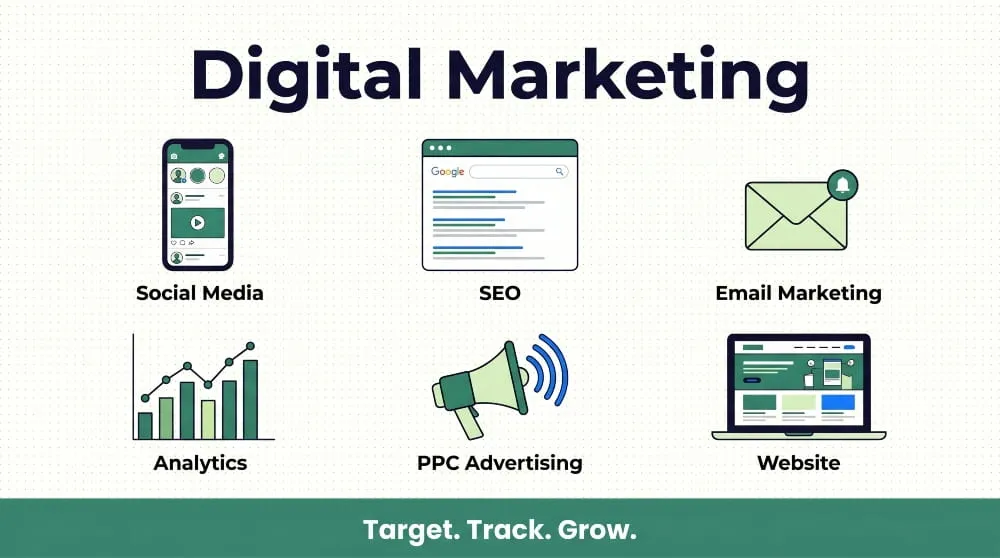
At its core, digital marketing is about reaching the right person, at the right time, with the right message, and then measuring exactly what happened after.
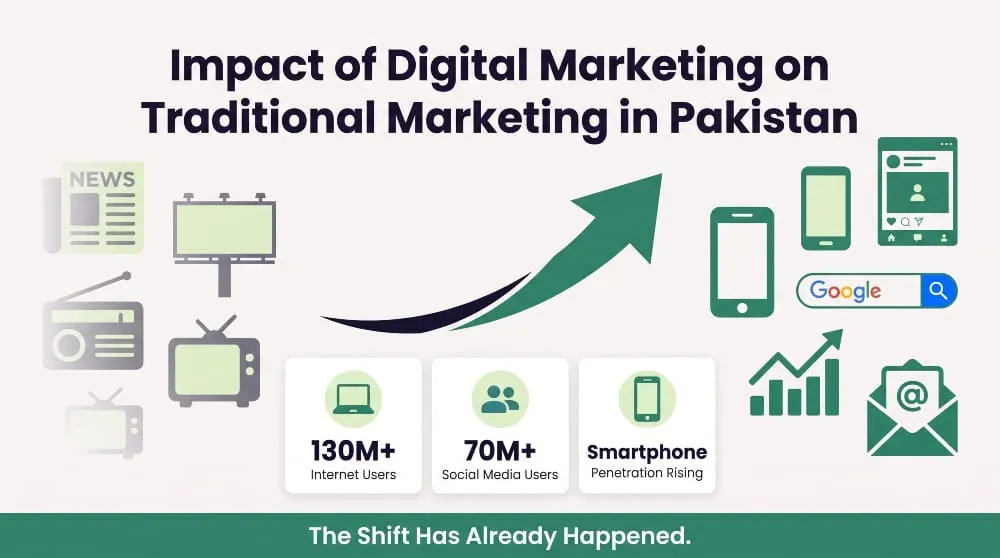
Pakistan’s digital landscape has grown dramatically. With over 130 million internet users, more than 70 million active social media users, and smartphone penetration rising every year, the audience is already online. The question is no longer whether your customers are on the internet; it’s whether your business shows up when they search for what you sell.
Digital marketing covers a wide range of channels and strategies:
- SEO (Search Engine Optimization), getting your website to rank on Google when people search for your products or services
- Social Media Marketing, building your brand, and engaging customers on Facebook, Instagram, TikTok, and LinkedIn
- PPC / Google Ads, paid advertisements that appear at the top of search results
- Content Marketing, blogs, videos, and guides that attract and educate your audience
- Email Marketing, direct communication with your existing customers and leads
- Influencer Marketing, partnering with Pakistani creators and personalities to promote your brand
What separates digital marketing from everything that came before it is one word: accountability. Every click, every view, every conversion is tracked. You know exactly how many people saw your ad, how many clicked it, and how many bought something as a result. That level of clarity simply doesn’t exist in traditional marketing.
Traditional Marketing vs Digital Marketing: Key Differences
Understanding what each one is only gets you halfway there. The real question most Pakistani business owners are asking is: how are they actually different when it comes to running a business?
Here’s a clear, honest breakdown.
Cost
Traditional marketing is expensive, and the costs are largely fixed. A quarter-page ad in a major Urdu newspaper can cost tens of thousands of rupees. A billboard in a prime Karachi location runs into lakhs per month. A TV commercial, once you factor in production and airtime, is entirely out of reach for most small and mid-sized businesses.
Digital marketing, by contrast, can start with almost any budget. A Facebook or Instagram campaign can be launched with a few thousand rupees and scaled up only when it’s producing results. You’re not paying for space or airtime, you’re paying for attention, and you control exactly how much you spend.
Reach & Targeting
Traditional marketing casts a wide net. A radio ad plays for everyone tuned in, whether they’re your ideal customer or not. You’re paying to reach a large, general audience and hoping the right people are listening.
Digital marketing flips this entirely. You can target a 28-year-old woman in Islamabad who owns a small business, uses an iPhone, and has shown interest in marketing tools, and show your ad only to her. That level of precision was unimaginable a generation ago, and it’s now standard practice for businesses of every size in Pakistan.
Measurability
This is perhaps the sharpest difference between the two. With a newspaper ad or a billboard, you have no reliable way of knowing how many people saw it, how many were interested, or how many became customers as a result. You’re making an educated guess.
With digital marketing, everything is measured. You know your reach, your click-through rate, your cost per lead, and your return on investment, in real time. This means you can make smarter decisions, cut what isn’t working, and double down on what is.
Speed
Traditional marketing moves slowly. Designing, printing, and distributing a campaign takes days or weeks. Booking a TV slot requires planning. If something isn’t working, changing course is slow and costly.
Digital marketing moves at the speed of the internet. A campaign can go live today. If an ad isn’t performing, you pause it and try a different approach, sometimes within hours. This agility is a significant advantage, especially for growing businesses that need to adapt quickly.
Engagement
Traditional marketing is a one-way street. The brand speaks, the audience listens, and that’s the end of the interaction. There’s no conversation, no feedback, no real-time relationship.
Digital marketing is a two-way channel. Customers can comment, share, reply, ask questions, and leave reviews. A Pakistani brand on Instagram isn’t just broadcasting, it’s building a community. That ongoing relationship is something no billboard can create.
Side-By-Side Comparison
| Factor | Traditional Marketing | Digital Marketing |
|---|---|---|
| Cost | High, fixed | Flexible, scalable |
| Targeting | Broad, general | Precise, specific |
| Measurability | Difficult | Real-time, detailed |
| Speed | Slow to launch | Immediate |
| Engagement | One-way | Two-way |
| Reach | Local / national | Local, national & global |
| Adaptability | Low | High |
Advantages of Digital Marketing Over Traditional Marketing
If the previous section gave you a clear picture of how they differ, this section answers the more practical question most Pakistani business owners eventually ask: so why should I choose digital?
The honest answer is, you don’t always have to choose. But when it comes to consistent, measurable, and scalable growth, digital marketing holds advantages that traditional marketing simply cannot match. Here’s why.
It Levels the Playing Field
In traditional marketing, the budget determines visibility. A large corporation can afford prime-time television. A small business in Faisalabad cannot. Digital marketing removes that barrier. A well-optimized Google listing, a strong Instagram presence, or a targeted Facebook campaign can put a small Pakistani business in front of the same audience as a much larger competitor, sometimes at a fraction of the cost.
Your Results Are Measurable, Down to the Rupee
One of the biggest frustrations with traditional marketing is not knowing what’s working. You spend on a newspaper ad and hope for the best. Digital marketing eliminates that guesswork. Every campaign tells you exactly how many people saw it, how many took action, and what it cost you to acquire each customer. For a business trying to grow responsibly, that clarity is invaluable.
You Can Reach the Right People, Not Just Any People
Paying to reach people who will never buy from you is wasted money. Digital marketing lets you define your audience with remarkable precision, by location, age, interests, online behavior, and even income level. A clothing brand in Lahore can target women aged 18–35 in DHA and Gulberg specifically. A software company in Karachi can reach IT managers across Pakistan. That kind of targeting is simply not possible through a billboard or a newspaper.
It Works Around the Clock
A shop closes at night. A billboard is invisible in the dark. But a well-ranked website, an active social media profile, or a running Google Ads campaign works 24 hours a day, seven days a week, generating leads and visibility even while you sleep. For Pakistani businesses looking to scale without proportionally scaling their team, this is a powerful advantage.
It Builds Long-Term Assets
A newspaper ad disappears the next day. A TV commercial runs its slot and is gone. Digital marketing, done right, builds assets that compound over time. A blog post that ranks on Google keeps driving traffic for years. A strong social media following continues to grow. An email list keeps delivering returns with every campaign. The effort you put in today continues working for your business long into the future.
It Opens the Door to Global Customers
This is particularly relevant for Pakistani businesses. Digital marketing doesn’t respect borders. A freelancer in Rawalpindi, a clothing exporter in Sialkot, or a software house in Lahore can reach clients in the UK, UAE, or the US with the same tools and platforms they use to reach local customers. Traditional marketing could never offer that kind of reach at an accessible cost.
Traditional Marketing vs Digital Marketing, Real-World Examples
Theory makes sense on paper. But sometimes the clearest way to understand the difference between traditional and digital marketing is to see how real businesses actually use them, and what happens when they do.
Here are three scenarios that reflect the kind of decisions Pakistani businesses face every day.
Example 1: a Lahore Clothing Brand Using Both Channels
A mid-sized women’s clothing brand in Lahore has been running for eight years. Historically, they invested in newspaper ads in Jang, seasonal billboards on Main Boulevard, and pamphlet distribution around their store in Gulberg.
The brand was well-known locally, but growth had plateaued. They couldn’t tell which of their marketing efforts was actually driving customers through the door, and expanding to other cities felt financially risky.
When they introduced digital marketing alongside their existing efforts, the results shifted quickly. Instagram became their strongest sales channel. Targeted Facebook ads reached women in Islamabad and Karachi who had never heard of the brand. Their website, once just a basic page, started generating online orders from across Pakistan.
The billboard still runs during Eid, because local brand visibility matters. But digital now drives the growth, and every rupee spent online is tracked and accounted for.
Example 2, a Karachi Restaurant: Banners vs. Instagram Ads
A family restaurant in Karachi’s PECHS area had always relied on a large signboard outside, occasional ads in a local weekly, and word of mouth. It worked well enough; the place had regulars and steady footfall.
But when a new competitor opened two streets away and started aggressively marketing on Instagram and Google Maps, the difference became visible almost immediately. The competitor had hundreds of tagged photos and active Stories, and showed up first when anyone searched for “restaurants in PECHS.”
The original restaurant responded by setting up a proper Google Business profile, running a modest Instagram campaign to showcase its food, and encouraging customers to leave reviews. Within two months, they were not only competing but also recapturing their position in the neighborhood and reaching customers from areas they’d never drawn from before.
The signboard is still there. But it’s no longer doing the heavy lifting.
Example 3: a Pakistani Startup That Went Fully Digital
A tech startup based in Islamabad offering HR software for small businesses made a deliberate decision from day one: no traditional marketing budget whatsoever. Everything went into SEO, LinkedIn advertising, and content marketing.
Within their first year, their blog was ranking for multiple relevant search terms across Pakistan. LinkedIn campaigns were reaching HR managers and business owners directly. A steady stream of inbound inquiries was coming in, people who had found them through Google, read their content, and reached out already convinced of the value.
Their customer acquisition cost was a fraction of what a comparable traditional campaign would have required. And because they’d built SEO and content assets, the returns kept improving over time without increasing the budget proportionally.
No newspaper. No billboard. No TV. Just digital, and it was enough.
These three examples illustrate an important point: there is no single right answer. The mix depends on your business, your audience, and your goals. But in each case, digital marketing provided something traditional marketing could not: precision, measurability, and the ability to reach beyond physical boundaries.
Impact of Digital Marketing on Traditional Marketing in Pakistan
Something significant has happened to the marketing landscape in Pakistan over the last decade, and it’s worth understanding clearly, because it affects every business decision you make about where to spend your marketing budget.
Digital marketing hasn’t just grown. It has fundamentally changed the role of traditional marketing.
Is Traditional Marketing Dying in Pakistan?
Not dying, but it is shrinking in influence and, more importantly, in trust.
Pakistani consumers, particularly in urban centers like Karachi, Lahore, and Islamabad, have changed how they make purchasing decisions. Before buying a product, booking a service, or visiting a restaurant, most people now search online, check reviews, scroll through social media, or ask in a WhatsApp group. The billboard they passed on the way to work might create awareness, but it’s rarely what closes the decision.
This shift in consumer behavior means that traditional marketing, even when it reaches people, often no longer reaches them at the moment that matters most, the moment they’re ready to act.
How Consumer Behavior Has Shifted
The numbers tell a clear story. Pakistan now has over 130 million internet users. Mobile internet usage has surged, with a large portion of the population accessing everything, news, entertainment, shopping, and communication, through their smartphones. Social media platforms like Facebook, Instagram, TikTok, and YouTube have become part of daily life for tens of millions of Pakistanis across all age groups.
What this means, practically, is that the average Pakistani consumer spends several hours a day in digital spaces. Their attention has moved online. And wherever attention goes, effective marketing must follow.
Which Industries in Pakistan Still Rely on Traditional Marketing?
To be fair, traditional marketing hasn’t lost its relevance everywhere. Certain industries and markets in Pakistan still depend on it meaningfully.
Large FMCG brands, the kind that sell cooking oil, tea, or soap to mass markets across urban and rural Pakistan, still invest heavily in television because their audience is broad and television remains widely consumed. Real estate developers continue to use billboards and newspaper inserts because their buyers are often older and make long, deliberate purchase decisions. Political campaigns still blanket cities with banners and posters because visibility at scale still carries weight.
In rural Pakistan, where internet access is still growing, traditional marketing remains the more dominant channel, and that’s a significant portion of the population that brands serving those markets cannot ignore.
But for most businesses, particularly small and mid-sized enterprises in Pakistan’s major cities, the balance has tilted decisively. Digital marketing now delivers more reach, greater precision, and a more measurable return than traditional channels can at a comparable budget.
The impact of digital marketing on traditional marketing in Pakistan isn’t a story of one replacing the other overnight. It’s a story of priorities shifting and smart businesses recognizing where their customers’ attention actually lives.
Integrating Traditional and Digital Marketing: the Hybrid Strategy
Here’s something most marketing guides won’t tell you: the businesses seeing the strongest results in Pakistan today aren’t choosing between traditional and digital marketing. They’re combining both, deliberately and strategically.
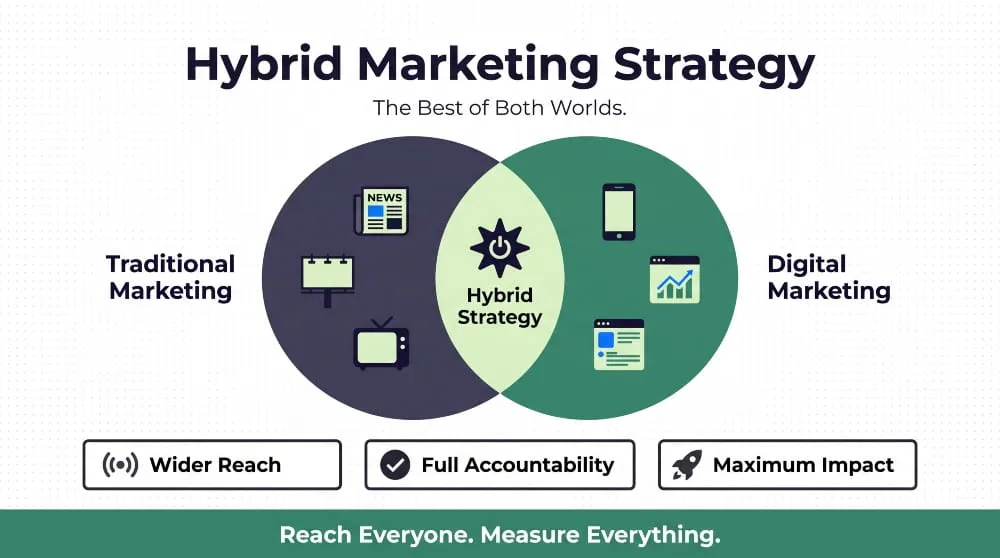
This is called an integrated marketing strategy, and when it’s done right, the two channels don’t just coexist; they amplify each other.
What Is an Integrated Marketing Strategy?
An integrated marketing strategy means delivering a consistent brand message across multiple channels, both online and offline, so that every touchpoint reinforces the same identity, offer, and trust.
Think of it this way: a potential customer sees your billboard on the way to work. Later that evening, they come across your Instagram ad. The next morning, they Google your brand name and find a well-built website with strong reviews. By the third touchpoint, they already feel like they know you. That familiarity is what converts a stranger into a customer, and it only happens when your channels are working together, not in isolation.
How to Transition From Traditional to Digital Marketing
For many established Pakistani businesses, the challenge isn’t understanding digital marketing; it’s making the shift without losing what already works.
The transition doesn’t have to be abrupt. The smarter approach is gradual and parallel. Start by building your digital presence alongside your existing traditional efforts. Set up and fully optimize your Google Business profile. Create active, consistent social media accounts. Build or improve your website. Run small, targeted digital campaigns and measure the results honestly.
As your digital channels begin producing measurable returns, you’ll naturally find clarity on where your budget is best spent. Some traditional channels will prove worth keeping. Others will become harder to justify once you can see the comparison in real numbers.
The goal isn’t to abandon traditional marketing; it’s to make every rupee you spend accountable.
Building a Hybrid Campaign: a Practical Approach for Pakistani Businesses
A hybrid campaign uses traditional marketing for broad awareness and digital marketing for precise conversion. Each does what it does best.
For example, a real estate developer launching a new project in Bahria Town Lahore might use newspaper ads and billboards to build widespread awareness and credibility in the city. Simultaneously, they run targeted Facebook and Google campaigns aimed specifically at overseas Pakistanis, a high-value segment that a billboard in Lahore will never reach. The offline campaign builds trust. The online campaign closes leads.
Another example: a clothing brand running a seasonal Eid campaign might invest in a television commercial for emotional brand impact, the kind of storytelling that television still does beautifully. But they pair it with an Instagram campaign, an exclusive discount code for online shoppers, and a WhatsApp broadcast to their existing customer list. Each channel plays a specific role, and together they create a campaign with far greater reach and measurability than either could deliver on its own.
Tools Pakistani Businesses Can Use to Bridge Both Worlds
The good news is that connecting your traditional and digital efforts is more accessible than ever. A few practical tools worth knowing:
QR codes bridge the gap between the physical and digital worlds effortlessly. A QR code on a pamphlet, a packaging insert, or a storefront sign can send a customer directly to your website, a special offer, or your WhatsApp business account in seconds.
UTM tracking links let you measure how much traffic and how many conversions are coming specifically from your offline campaigns, so you finally know whether that newspaper ad actually drove results.
WhatsApp Business has become one of the most powerful marketing tools in Pakistan precisely because it bridges both worlds, personal, direct, and digital, all at once.
Google Business Profile ensures that anyone who hears about your brand through traditional channels and then searches for you online finds a complete, professional, and trustworthy presence immediately.
The businesses that will dominate their markets in Pakistan over the next five years won’t be the ones who chose digital over traditional; they’ll be the ones who learned how to use both intelligently.
Which Is Better for Your Business, Traditional or Digital Marketing?
This is the question everything has been building toward. And the honest answer is: it depends, but not in a vague, unhelpful way. There are clear, practical factors that should guide your decision, and by the end of this section, you’ll know exactly where your business stands.
When Traditional Marketing Still Makes Sense
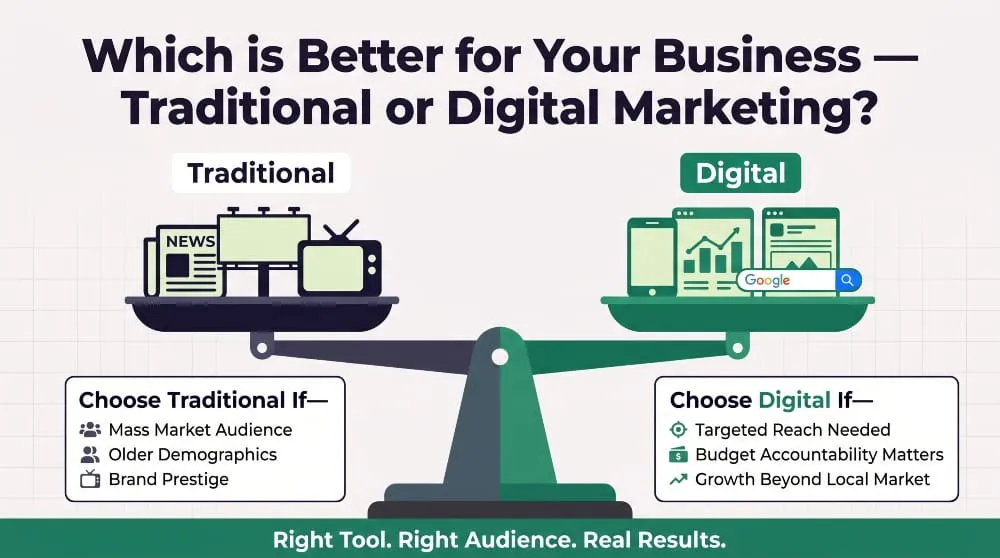
Traditional marketing remains a smart investment in specific situations. If your target audience is older, say, 50 and above, and their media consumption is still heavily television and newspaper-based, then being present in those channels makes sense. You go where your audience is, not where the trend is.
If you’re running a business that serves a broad, mass-market audience across Pakistan, think of a consumer goods brand, a telecom company, or a nationwide retail chain. The sheer reach of a TV campaign or a major newspaper ad still carries value that digital alone cannot replicate at the same scale of awareness.
Traditional marketing also works well for building long-term brand prestige. A consistent presence in quality print publications or a well-produced television commercial still carries a certain credibility in the Pakistani market, particularly for industries like real estate, banking, and luxury goods, where trust and reputation are everything.
And for businesses operating primarily in areas with lower internet penetration, smaller cities, rural markets, or specific demographic segments, traditional channels remain the more practical and effective choice.
When Digital Marketing Is the Smarter Choice
For the vast majority of small and mid-sized businesses in Pakistan today, digital marketing is not just the smarter choice, it’s the more necessary one.
If your customers are between 18 and 45, urban, and smartphone users, which describes an enormous and growing segment of Pakistan’s population, they are spending their time online. That’s where they discover new brands, research purchases, read reviews, and make decisions. If your business isn’t visible in those spaces, you’re invisible at the moment that matters most.
Digital marketing is also the clear choice when budget accountability matters. If you need to know what your marketing spend is actually producing, and most growing businesses do, digital gives you that clarity in a way traditional marketing never can.
If you’re looking to grow beyond your local market, reach customers in other cities, or even tap into the Pakistani diaspora in the UK, UAE, or North America, digital is the only channel that makes that possible at a realistic cost.
And if you’re a new business building from scratch, digital marketing lets you establish a presence, build an audience, and generate leads without the high upfront costs traditional marketing demands.
A Simple Decision Framework
Before deciding where to invest your marketing budget, ask yourself these questions honestly:
Who is my customer? If they’re young, urban, and online, digital is your primary channel. If they’re older, rural, or heavy traditional media consumers, traditional media deserves a place in your mix.
What is my budget? If it’s limited, digital gives you more control, more targeting, and more measurability per rupee spent. Traditional marketing rewards larger budgets.
What am I trying to achieve? On a mass scale, traditional media can help with brand awareness. Generating leads, driving website traffic, building a community, or selling online, digital is built for this.
Can I measure the result? If accountability matters to your business decisions, and it should, digital marketing is the only channel that gives you real answers.
Am I trying to grow beyond my current location? If yes, digital is non-negotiable.
The truth is, this isn’t really a competition. Traditional and digital marketing are tools, and like any tools, their value depends entirely on how and where you use them. The businesses that grow consistently in Pakistan are the ones that ask the right questions first, then choose accordingly.
Ready to Grow Your Business with Digital Marketing?
Understanding the difference between traditional and digital marketing is the first step. But knowledge only creates results when it’s put into action, and that’s where most businesses get stuck.
You might know that SEO matters, that social media builds brands, and that Google Ads can drive leads. But knowing what needs to be done and actually doing it well are two very different things. Digital marketing done right requires strategy, consistency, technical expertise, and constant optimization. It’s not a one-time task; it’s an ongoing process that compounds over time.
That’s exactly what DMSVX was built for.
How DMSVX Helps Pakistani Businesses Go Digital
DMSVX is a results-driven digital marketing agency working with businesses across Pakistan and internationally. We don’t offer generic packages or one-size-fits-all solutions. Every strategy we build starts with a clear understanding of your business, your audience, and what growth actually means for you.
Whether you’re a small business in Lahore looking to reach more local customers, an e-commerce brand in Karachi aiming to scale online sales, or an established company ready to expand beyond Pakistan, we build digital strategies that are specific, measurable, and designed to deliver real returns.
Our Digital Marketing Services in Pakistan
At DMSVX, we offer a full suite of digital marketing services that cover every stage of your customers’ journey, from the moment they first discover your brand to the moment they become loyal customers.
Our core services include Search Engine Optimization (SEO), Social Media Marketing, Pay-Per-Click Advertising (Google & Meta Ads), Content Marketing, and Email Marketing. Each service is delivered with a focus on strategy first, because the right execution of the wrong strategy produces nothing.
Get a Free Digital Marketing Audit for Your Business
Not sure where your business stands digitally? Start with clarity.
We offer a free digital marketing audit for Pakistani businesses, an honest, no-obligation assessment of your current online presence, what’s working, what isn’t, and where the biggest growth opportunities are hiding.
No pressure. No generic advice. Just a clear picture of where you are and what it would take to get where you want to be.
DMSVX, Digital Marketing Services Expert. Helping Pakistani businesses grow online, compete globally, and build digital assets that last.
The debate between traditional and digital marketing isn’t really about which is superior; it’s about understanding what each does well and making smarter budget decisions.
Traditional marketing built some of Pakistan’s most recognized brands. Digital marketing is now building the next generation of them, faster, leaner, and with far greater accountability.
If there’s one takeaway from this guide, it’s this: your customers are online, their attention is digital, and the businesses that meet them there consistently are the ones growing right now.
Whether you’re just starting or ready to take your marketing to the next level, the direction is clear.
The only question is how quickly you move.
Frequently Asked Questions
Is Digital Marketing Better Than Traditional Marketing in Pakistan?
For most businesses in Pakistan today, yes, digital marketing delivers better results per rupee spent. It offers precise targeting, real-time measurability, and the ability to reach customers across Pakistan and beyond without the high fixed costs of traditional channels. That said, “better” depends on your specific audience and goals. Large brands serving mass markets may still find value in television and print, while most small and mid-sized businesses will see stronger, more accountable returns from digital marketing.
Can Small Businesses in Pakistan Afford Digital Marketing?
Absolutely. This is one of digital marketing’s greatest advantages. Unlike traditional marketing, where a single newspaper ad or billboard can cost tens of thousands of rupees with no guaranteed return, digital marketing can begin with a modest budget and scale as results come in. A well-managed Facebook campaign, a properly optimized Google Business profile, or a consistent Instagram presence can be built and maintained at a cost that almost any Pakistani business can manage. The barrier to entry is low. The potential return is not.
What Is the Main Difference Between Traditional and Digital Marketing?
The most fundamental difference is accountability. Traditional marketing broadcasts your message to a wide audience, with limited control over who sees it and no reliable way to measure the results. Digital marketing puts you in control of who sees your message, when they see it, how much you spend, and exactly what results it produces. Beyond that, digital marketing is two-way: it allows real interaction between a brand and its audience, something traditional marketing was never designed to do.
How Has Digital Marketing Impacted Traditional Marketing in Pakistan?
Digital marketing has shifted where Pakistani consumers spend their attention, and as a result, it has reduced the dominance that traditional channels once had over purchasing decisions. Consumers now research online before they buy, check reviews before they visit, and discover brands through social media before they ever see a billboard. This doesn’t mean traditional marketing has stopped working; it means it can no longer do the job alone. The impact has been a forced evolution: businesses that once relied entirely on traditional channels now need a digital presence to remain competitive.
Should I Use Both Traditional and Digital Marketing Together?
If your budget allows it and your audience spans multiple channels, yes, a hybrid approach is often the most effective strategy. Traditional marketing builds broad awareness and brand credibility. Digital marketing converts that awareness into leads, sales, and measurable growth. When both are aligned around the same message and goal, they reinforce each other in a way that neither can achieve alone. For most Pakistani businesses, the practical starting point is to build a strong digital foundation, then layer in traditional channels that add genuine value.
Want Results Like This for Your Business?
Let's talk about what's actually possible for your industry and city.