SEO Audit Report | What You Should Get From an Audit in Pakistan
A good SEO audit report shows what is wrong on your website, why it matters, how serious it is, and what to fix first, with a clear action plan. It is not a raw tool printout of scores and warnings. If a report cannot tell you what to do next, it is not really an audit.
What Is an SEO Audit Report?
An SEO audit report is a written review of your website that lists the problems and missed opportunities affecting your search visibility, and ranks them by importance. It answers three questions: what is holding the site back, how much it matters, and what to do first. If you are paying for an audit, this document is the product you receive.
SEO Analysis, Audit and Report: What’s the Difference
The three terms overlap, but they are not identical. An SEO analysis looks at how your site is performing and why, and an SEO audit is a structured check against a standard list of technical, on-page, and content factors. The report is the written result of either. In practice, agencies use the words loosely, so judge the document by what it contains rather than what it is called.
SEO Audit vs Monthly SEO Report
An audit is a deep one-time check, usually done at the start of a project or after a major change. A monthly SEO report is a short update that shows what was done and what happened, such as traffic, rankings, and inquiries. You need both, but they answer different questions. The audit tells you where to start, and the monthly report shows whether the work is paying off.
What a Good SEO Audit Report Should Include
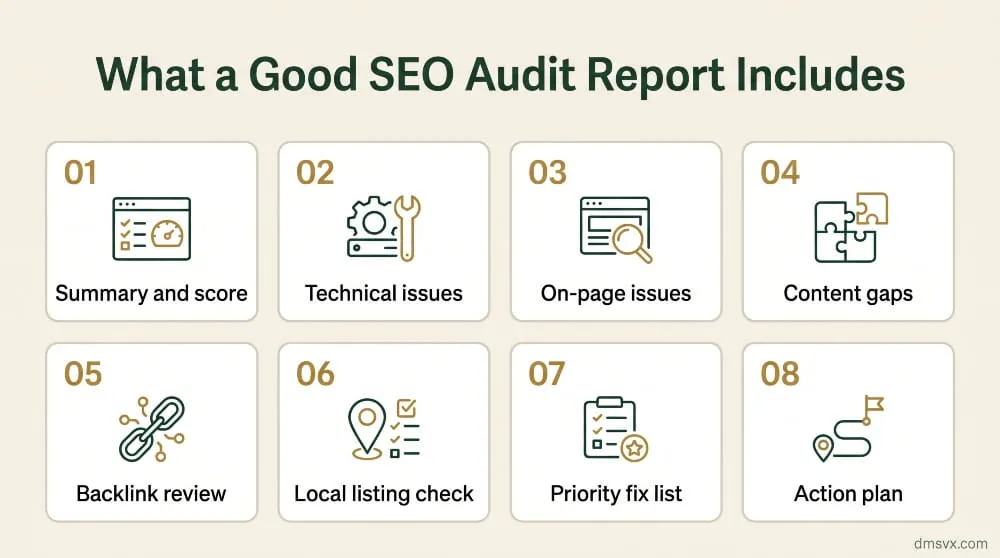
A complete SEO audit report should include eight parts: a summary with an overall health view, technical findings, on-page findings, content and keyword gaps, a backlink review, a local check where relevant, and a prioritized action plan. Whether you call it a complete report, a detailed report, or a full website SEO audit, it should cover these areas and explain each in plain language.
Summary and Overall Health
The first page should tell a business owner, in a few lines, how healthy the site is, what the biggest problems are, and what the report recommends. An SEO health score can be a useful quick indicator, but it should never replace the explanation. If you need to read twenty pages to understand the main message, the report has been written for the tool, not for you.
Technical Findings
This section covers whether search engines can find, read, and index your pages: crawl errors, indexing, site structure, mobile usability, security, and page speed. Speed matters because visitors leave. A 2016 Google study found that 53% of mobile visits were abandoned when a page took longer than three seconds to load. A good report names the slow pages and the likely causes, and does not just show a score.
On-Page Findings
On-page findings look at what is on each important page: titles, descriptions, headings, text, images, and internal links. The report should show which pages are missing or repeating titles, which are thin, and which target the wrong search. It should point to specific pages, not give general advice that could apply to any site.
Content and Keyword Gaps
This section shows which searches your customers use that your site doesn’t answer well, and which pages compete with each other. It should compare your content with what ranks for the searches that matter to your business. The result is a list of pages to create, improve, or merge, not just a list of keywords.
Backlink Review
A backlink review checks which websites link to you, whether those links are relevant and trustworthy, and whether any look spammy or unnatural. It also compares your link profile with that of your main competitors. If the report shows only a total link count, it tells you very little.
Local and Google Business Profile Check
If you serve customers in a city or area, the audit should check your Google Business Profile, your business details across the web, your reviews, and your local pages. These findings often lead to the quickest gains for service businesses. If local customers matter to you, ask for this section specifically.
A Prioritized Action Plan
The action plan is the most valuable part. It lists each fix, why it matters, how much effort it takes, and what order to follow. Without it, you have a list of problems and no way to decide where to spend money. A good plan separates quick wins from larger projects and assigns a clear owner to each.
SEO Audit Report Example: How a Good One Is Laid Out
A good SEO audit report follows a simple structure that a non-expert can read from top to bottom. The first page gives the summary and the three to five most important findings. The next pages cover technical, on-page, content, link, and local findings, each with a short explanation, the pages affected, and a recommended fix. The last pages hold the prioritized action plan and the next steps.
Each finding should follow the same pattern: what we found, why it matters, how serious it is, and what to do. Screenshots or page examples help, because they show exactly where the problem is. If a sample report from an agency lacks this pattern and reads like a list of warnings, treat it as a tool export.
Tool Report vs Expert Audit
A tool report is generated automatically from a site scan, while an expert audit adds human judgment about what matters for your business. Both are useful, but only the second tells you what to do and in what order.
What Tools Do Well
Tools quickly and thoroughly find technical issues across many pages, such as broken links, missing titles, redirect problems, and slow pages. They give a consistent baseline and are a good starting point. A free report can show whether obvious problems exist.
What Only an Expert Adds
A tool cannot tell you which issues matter for your goals, which are false alarms, or how your site compares with the competitors your customers actually choose. An expert reads the results in context, checks the pages by hand, ignores noise, and builds a plan around your business. That is the difference between a printout and a real SEO audit service in Pakistan.
How to Read Your Report: Fix First, Fix Later
The simplest way to read an audit report is to sort every finding by impact and effort. Fix high-impact, low-effort issues first; plan larger, high-impact projects next; handle small, easy fixes when convenient; and skip low-impact, high-effort items for now.
A missing page title on your main service page is a quick, high-impact fix. Rebuilding your entire site structure is high-impact but a larger project, so it needs planning. Many reports list hundreds of small warnings, and most do not deserve attention. Ask the author to mark which issues matter, and concentrate on those first.
Red Flags in an SEO Audit Report
The main red flags in an SEO audit report are a generic tool printout, no prioritization, no mention of your business goals, huge numbers of unexplained warnings, and promises of guaranteed rankings. Any one of these suggests the report is meant to impress, not to help.
Also be wary of reports delivered with a price attached before anyone has talked to you, or that recommend the same list of fixes for every business. Real case studies from the agency show how its audits turn into actions, so ask to see how past reports were used.
Free vs Paid SEO Audit
A free SEO audit is a good way to see how an agency thinks, but it is usually shorter and more automated than a paid one. A paid audit goes deeper, includes manual checks, and ends in a plan you can follow. The right choice depends on what you need to decide.
If you are comparing agencies, a free marketing audit lets you judge the quality of the findings before you spend anything. If you already know you need to fix a large or complex site, a full audit with a prioritized plan is worth paying for. Either way, ask who prepared the report and whether a person will explain it to you.
Frequently Asked Questions (FAQ)
How Long Should an SEO Audit Report Be?
The length should follow your site, not a template. A small business site needs a shorter report than a large online store. What matters is a clear summary on the first page, specific findings by section, and a prioritized plan at the end.
How Often Should I Get an SEO Audit?
Most websites benefit from a full audit about once a year, and again after a redesign, a platform change, or a sudden drop in traffic. Between audits, a monthly report tracks progress and flags new problems early.
Can I Trust a Free SEO Audit?
You can trust a free audit as a starting point, but not as a full diagnosis. Automated free reports are good at spotting obvious technical problems and poor at judging what matters for your business. Treat the findings as questions to discuss with an expert.
What Should I Do After I Get the Report?
Sort the findings by impact and effort, fix the high-impact quick wins first, and schedule larger projects in order. If you do not have the time or skills, hand the action plan to a provider. Our SEO services in Pakistan can take the plan forward, including technical SEO, on-page SEO, off-page SEO, and local SEO.
What Is the Difference Between an Audit and an Analysis?
An SEO analysis explains how your site is performing and why, while an SEO audit checks your site against a set list of factors and records what needs fixing. In practice, the two overlap, and the written result is the report. What matters is that the document ends with clear priorities.
Get a Free Marketing Audit for Your Business.
The best way to see what a good audit looks like is to receive one for your own site. Ask DMSVX for a free marketing audit, and you will get a clear view of what to fix first, with no obligation to continue. When you are ready, contact us, and we’ll walk you through the findings. [add DMSVX proof]
Want Results Like This for Your Business?
Let's talk about what's actually possible for your industry and city.
Keep reading