SEO Agency vs Freelancer vs In-House Team in Pakistan: Which Should You Hire?

An agency suits most growing businesses that need several skills and reliable cover. A freelancer suits a small, specific task on a limited budget. An in-house hire suits larger companies with enough constant SEO work to keep a full-time specialist busy.
SEO Agency vs Freelancer vs In-House: the Quick Comparison
The three options differ mainly in skills, cost, reliability, and fit. An agency gives you a team of specialists at a mid- to high-level cost, a freelancer gives you one or two skills at the lowest upfront cost, and an in-house hire gives you a dedicated person at the highest cost. Each can work, so the right choice depends on how much SEO work you actually have.
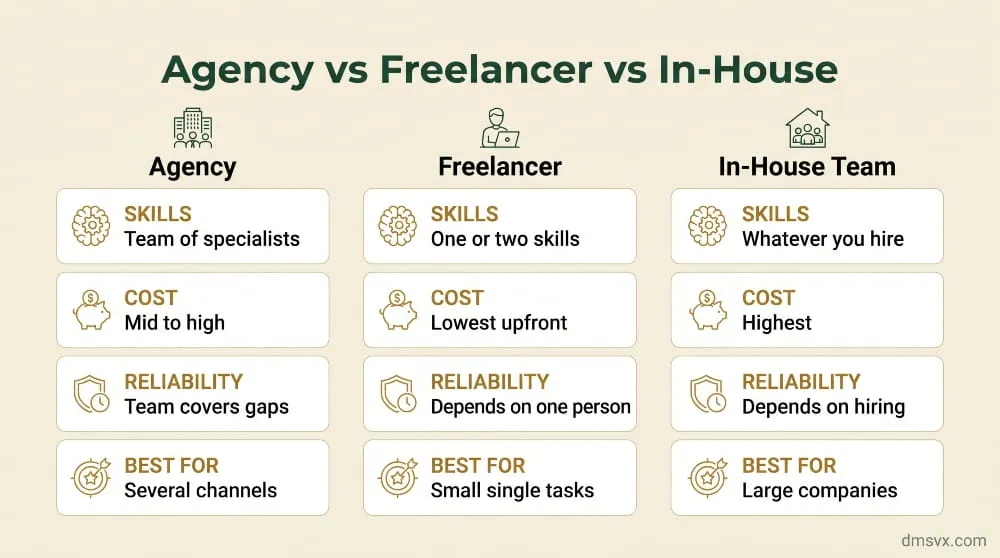
Think of it as a question of workload and risk. A small task needs one skilled person. A growing site needs technical, content, and link work at the same time, which rarely fits in one person. A large company with constant SEO needs may justify a full-time team. The sections below explain what each option gives you and where it falls short.
Hiring an SEO Agency
Hiring an SEO agency means paying a company to run your SEO with a team of specialists, usually with a defined process, reporting, and an account contact. It is the usual choice for growing businesses that need more than one skill and cannot afford gaps when one person is unavailable.
What You Get
An agency brings a team that can handle technical fixes, content, links, local SEO, and reporting. If one person is on leave or leaves the company, the work continues. Agencies also see many sites, so they often spot patterns early. If you want several channels managed together, our search engine marketing approach shows how SEO fits with paid search. For the full scope of what an agency does, see our SEO services in Pakistan.
Where Agencies Fall Short
Agencies usually cost more than a freelancer, and quality varies widely. Some hand your account to junior staff after the sales stage, and some rely on fixed packages that don’t fit your business. Ask who will do the work, how they report, and what is in writing. Look at real case studies before you commit.
Hiring an SEO Freelancer
Hiring an SEO freelancer means paying one independent person to do specific SEO work, often by the hour, by the project, or on a small monthly basis. It suits small tasks and tight budgets, as long as you choose carefully and keep your expectations realistic.
What You Get
A good freelancer gives you direct access to the person doing the work, flexible terms, and a lower cost than most agencies. Freelancers are a good fit for a one-off audit, a set of on-page fixes, a content plan, or a second opinion on what your current provider is doing. Communication is usually fast because there is no layer of account managers.
Where Freelancers Fall Short
A freelancer is one person, so your SEO depends on their availability, skills, and workload. Few freelancers are equally strong at technical SEO, content, and link building. If they are ill, busy, or move on, you may have no one to continue the work. Make sure your website and analytics accounts stay in your name so you can switch if you need to.
Building an In-House SEO Team
An in-house SEO team means employing people inside your company who work only on your site. It gives you control and deep knowledge of your business, but it is the most expensive route and needs enough ongoing work to keep the team busy.
What You Get
An in-house specialist knows your products, customers, and internal processes, and can work closely with your content, development, and sales teams. Decisions move quickly because they’re on your side every day. For a large company with a big website and constant changes, this closeness is a real advantage.
Where In-House Falls Short
One full-time hire rarely has every skill that SEO needs, so you may still need outside help for technical work, content, or links. Salaries, tools, and training add up, and replacing a single specialist can be hard. Hiring well takes time, and a poor hire is costly. A small business usually doesn’t have enough ongoing SEO work to justify it.
Outsource SEO or Hire In-House?
Outsourcing SEO makes sense when you need skills you do not have, want to start quickly, or have uneven workloads, while hiring in-house makes sense when SEO is a constant, central need. Many companies searching for an SEO outsourcing company or an outsourced SEO team are really asking whether they can afford to build that variety of skills in-house.
The main trade-off is control against flexibility. In-house gives you more control, but you carry the full cost and the hiring risk. Outsourcing gives you a team on demand and lets you scale up or down, but you must manage the relationship and check the work. A fair test is to estimate how many hours of SEO work you really have each month. If the answer is far below a full-time job, outsourcing is usually the more efficient choice.
Managed and Full-Service SEO: What It Means.
Managed SEO, sometimes called full-service SEO, means an agency handles the whole process for you: audit, strategy, fixes, content, links, and reporting. You approve the plan, and the agency does the work. It suits business owners who want results without learning SEO or managing several specialists.
The difference from a freelancer or a one-off project is ownership. In managed SEO, the agency handles planning and delivery on an ongoing basis. DMSVX is an online-only marketing agency, and you can read more about DMSVX and how we work with clients. [add DMSVX proof] Whichever provider you pick, ask exactly what is included and what is not.
How Each Option Is Paid: Retainer, Hourly, or Project
SEO providers are usually paid in one of three ways: a monthly retainer, an hourly rate, or a one-off project fee. Agencies mostly work on retainers, freelancers often use hourly or project pricing, and in-house staff are paid a salary. The right model depends on whether your SEO needs are ongoing or limited.
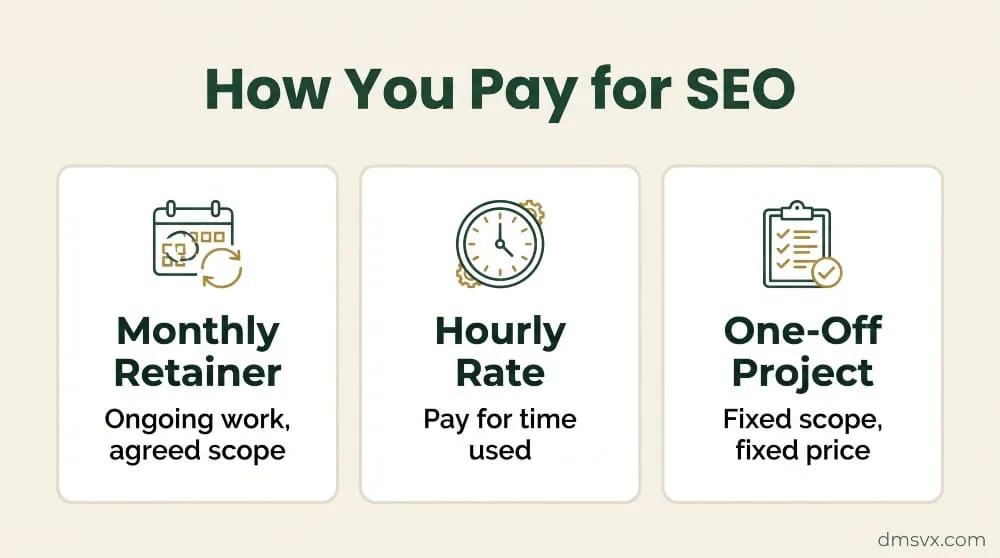
A retainer suits ongoing work with an agreed scope each month, which is how most SEO is done because results build over time. An hourly rate suits small or uncertain tasks, but costs can grow if the work is not tightly defined. A project fee suits a clear one-off job, such as an audit or a site migration, with a fixed scope and price. Ask any provider to explain exactly what you get under each model.
What a Good SEO Contract Should Say
A good SEO contract states what will be done each month, what is excluded, how and when you will receive reports, how long the commitment lasts, and how either side can end it. It should confirm that you own your website and analytics accounts. Google’s own guidance on hiring an SEO is that no one can guarantee a number one ranking, so be wary of any contract that promises one. A written scope protects both sides and makes progress easy to track.
Which Option Fits Your Business?
The right option depends on your size, the amount of SEO work, and how much risk you can accept. Use the situations below as a starting point, and begin with an SEO audit so your choice is based on what your site actually needs.
Small Local Business
A small local business with one location and a simple website often does well with a freelancer for a one-off setup, or with an agency on a modest plan if the budget allows. The priority is a complete Google Business Profile, clear service pages, and reviews, which is the focus of local SEO. An in-house hire is rarely justified at this size.
Growing SME or Online Store
A growing SME or online store usually needs technical fixes, content and links at the same time, so an agency is the safer fit. A single freelancer can cover part of this, but not all of it, and a store with a large catalog needs consistent work. If you are comparing options, a free marketing audit will show what your site needs before you decide.
Large Company
A large company with a big website and constant changes may justify an in-house specialist or team, often supported by an agency for specialist work. At this scale, SEO touches development, content, and product decisions daily, so having someone on the inside has real value.
Can You Combine Options?
Yes, combining options is common and often works best. A company might keep one in-house SEO lead to set direction and use an agency for technical work, content, and links. A small business might use a freelancer for a one-off audit and then hand the plan to an agency. What matters is that someone owns the plan and the results. For a wider view of how we work, see our Pakistan marketing services.
Frequently Asked Questions (FAQ)
Is It Cheaper to Outsource SEO?
Outsourcing is usually cheaper than building an in-house team, because you avoid salaries, tools, and hiring costs and pay only for the work you need. It is not always cheaper than a freelancer for a small task. The real comparison is cost against the skills and reliability you get.
Can a Freelancer Replace an Agency?
A freelancer can replace an agency for small, well-defined work, but rarely for ongoing SEO that needs technical, content, and link skills together. If the freelancer is strong in all those areas and has the time, it can work. Otherwise, you may end up paying for gaps later.
When Should I Hire In-House?
Hire in-house when SEO is a constant, central need, your website is large or changes often, and you have enough work to keep a full-time specialist busy. Many companies start with an agency or freelancer and move in-house once the workload is clear.
What Does Managed SEO Mean?
Managed SEO means a provider runs your SEO for you, including audit, strategy, fixes, content, links, and reporting. You approve the plan and review the results, and the provider handles the work. It is also called full-service SEO.
What Should an SEO Contract Include?
An SEO contract should include the monthly scope of work, what is excluded, reporting dates, the contract length, how to cancel, and who owns your accounts and content. It should not promise guaranteed rankings. Ask for the scope in plain language before you sign.
Get a Free Marketing Audit Before You Decide.
The best way to choose between an agency, a freelancer and an in-house hire is to see what your website actually needs. Ask DMSVX for a free marketing audit, and you will get a clear view of what to fix first, with no obligation to continue. When you are ready, contact us, and we will go through the findings with you.
Want Results Like This for Your Business?
Let's talk about what's actually possible for your industry and city.
Keep reading